Are We Smart Enough to Know How Smart Animals Are?
Frans de Waal · 2016 · Science
12 min · 11 chaptersNarrated in your voice
Original summary · AI-drafted, human-published · added by Library
What it's about
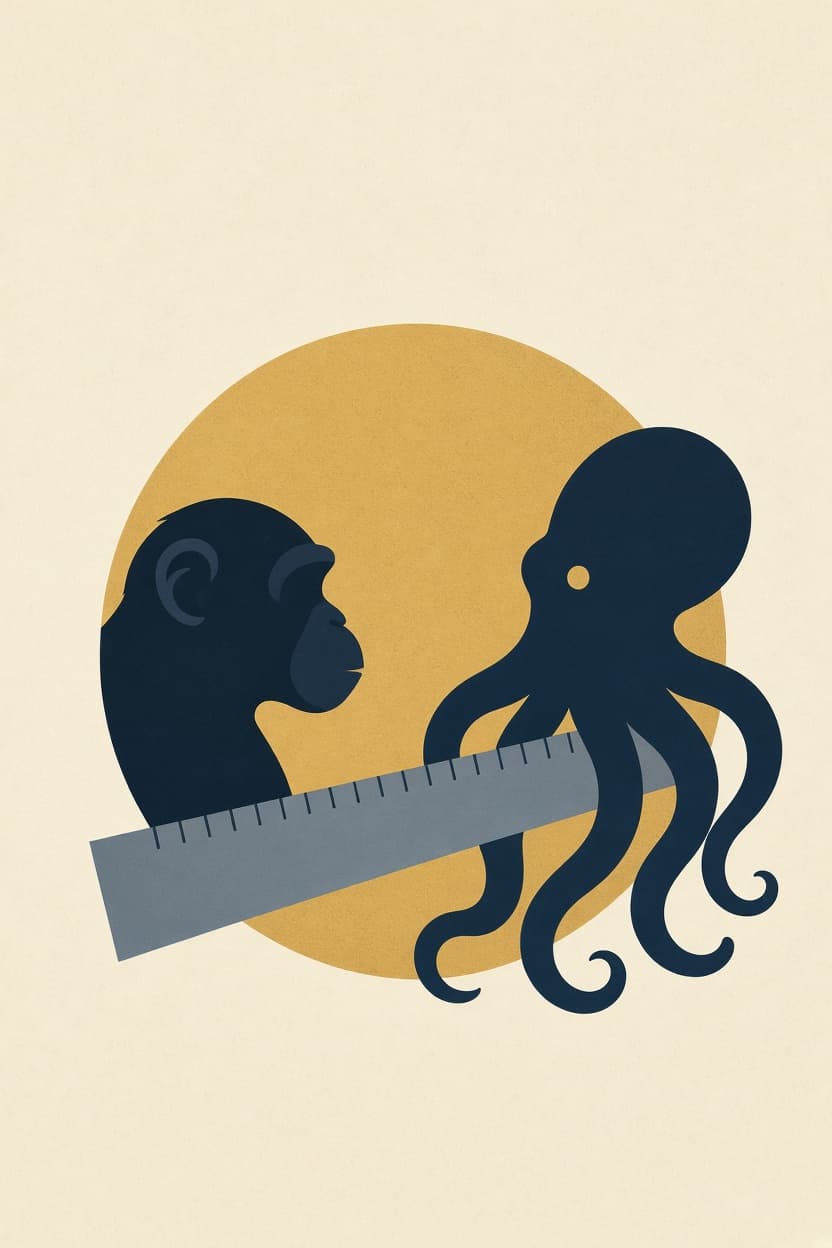
Frans de Waal, a primatologist, argues that decades of comparative cognition research have been distorted by a human-centered yardstick that measures animals against our own abilities and finds them lacking. Drawing on studies of chimpanzees, elephants, octopuses, and birds, he contends that intelligence takes many forms shaped by each species' ecology, and that dismissing non-human cognition as mere instinct reflects the limits of our tests, not the limits of animal minds. The book mattered for pushing cognitive ethology toward humility.
Reading plan
Pick a finish date and Genius lays out the days — the plan shows today's target and keeps you honest.
Read together
Start a circle and share the code — everyone sees everyone's honest place in the book. Accountability, not leaderboards.
Who it's for
- Readers curious about animal behavior who want more than viral videos of clever crows - Students or professionals in psychology, biology, or ethics rethinking what counts as intelligence - Anyone who has watched a pet or wild animal solve a problem and wondered what is really going on inside
What’s inside
- 1The Wrong Yardstick1 min
Most historical tests of animal intelligence failed because they measured animals against human-specific tasks rather than tasks suited to each species' senses and needs.
- 2Chimpanzee Politics and Planning1 min
Chimpanzees display strategic social intelligence and future planning that were long assumed to be uniquely human.
- 3The Octopus Problem1 min
Intelligence can evolve independently in radically different nervous systems, meaning cognition is not tied to any particular brain architecture including a centralized brain at all.
- 4Memory Without Words1 min
Animals such as elephants and corvids demonstrate long-term episodic-like memory and grief responses that suggest inner experience, not mere programmed reflex.
- 5Cooperation and Fairness1 min
A sense of fairness and willingness to cooperate for mutual benefit are evolutionarily old traits found across primates and even some birds, not recent products of human culture.
- 6Tool Use Beyond Primates1 min
Tool use and even tool manufacture occur across a wide range of species including birds and fish, showing that this ability is not a marker of higher intelligence unique to a few smart lineages.
- 7Rethinking Consciousness and Emotion1 min
Behavioral and physiological evidence for emotion in animals is strong enough that continuing to deny animal consciousness reflects philosophical caution outrunning the evidence, not the reverse.
- 8Redefining Smart1 min
Because intelligence is inseparable from the ecological niche a species evolved to fill, there is no single scale on which to rank species from dumbest to smartest.
About Frans de Waal
Frans de Waal (1948–2024) was a Dutch-American primatologist and ethologist who directed the Living Links Center at Emory University's Yerkes National Primate Research Center. Author of Chimpanzee Politics and Good Natured, he spent over four decades studying primate social behavior and became one of the most widely read popularizers of animal cognition science.
What readers say
Read next
An Immense WorldEd YongSummary17 min

IncognitoDavid EaglemanSummary10 min
MusicophiliaOliver SacksSummary12 min

The Code BreakerWalter IsaacsonSummary13 min

A Brief History of TimeStephen HawkingSummary17 min

Brief Answers to the Big QuestionsStephen HawkingSummary15 min