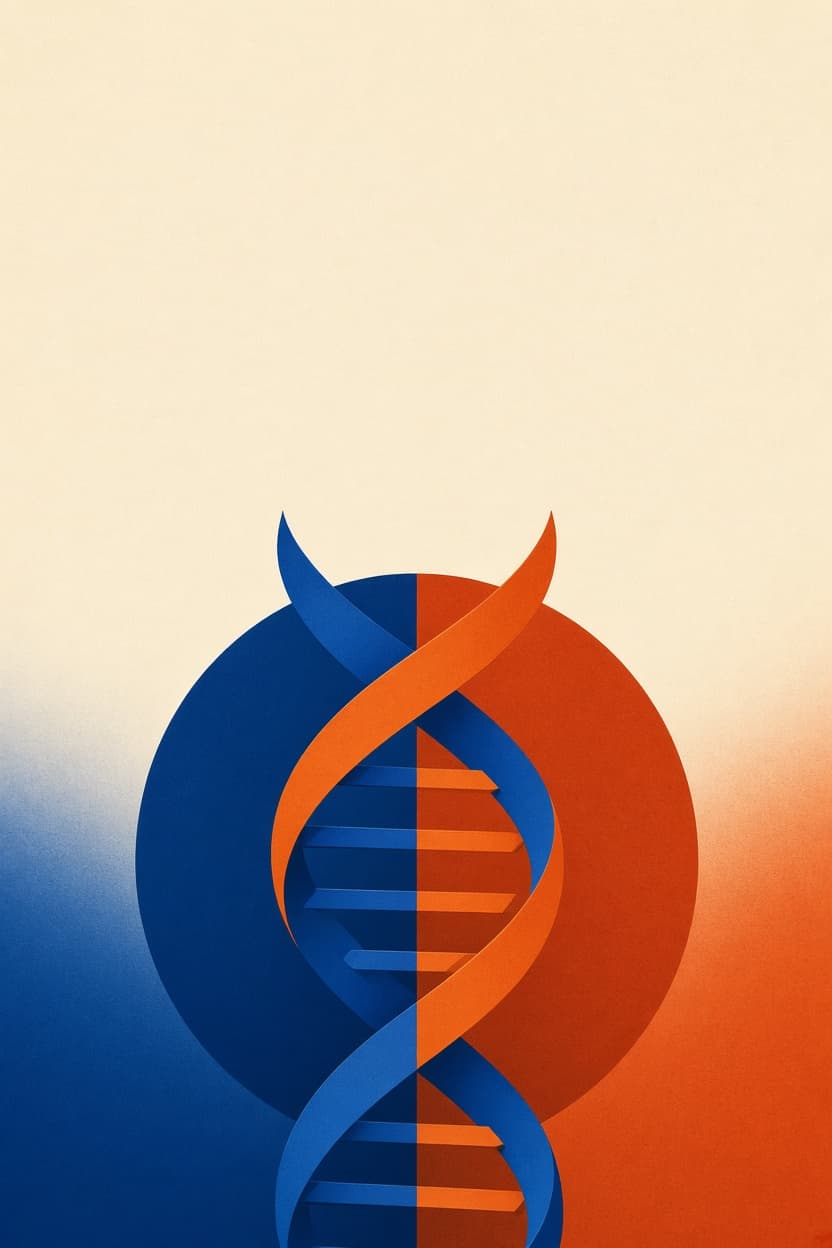
The Double Helix
A Personal Account of the Discovery of the Structure of DNA
James D. Watson · 1968 · Science
14 min · 12 chaptersNarrated in your voice
Original summary · AI-drafted, human-published · added by Library
What it's about
Watson's 1968 memoir recounts how he and Francis Crick raced to determine DNA's molecular structure at Cambridge in 1951-1953, beating rivals at King's College London and Caltech. Rather than presenting science as a tidy march toward truth, Watson depicts it as driven by ambition, rivalry, borrowed data, and luck. The book mattered because it stripped away the myth of the disinterested scientist and showed discovery as a messy, competitive, deeply human race.
Reading plan
Pick a finish date and Genius lays out the days — the plan shows today's target and keeps you honest.
Read together
Start a circle and share the code — everyone sees everyone's honest place in the book. Accountability, not leaderboards.
Who it's for
- Science students who want to see how a landmark discovery actually happened, warts and all - General readers curious about the personalities behind DNA's structure - Anyone interested in how ambition, rivalry, and luck shape research, not just intellect
What’s inside
- 1A Young American Abroad1 min
Watson argues that raw ambition and a willingness to trespass into fields he barely understood, more than formal training, put him in position to help crack DNA's structure.
- 2Meeting Crick1 min
Watson claims that his partnership with Francis Crick worked precisely because neither man had much to lose and both were considered outsiders by their respective fields.
- 3King's College and the Franklin Problem1 min
Watson's account portrays Rosalind Franklin's caution and skepticism as an obstacle to progress, a framing that later scholarship shows badly misjudged her scientific position.
- 4Pauling's Shadow1 min
The book argues that fear of losing to a superior rival, Linus Pauling, was a more effective motivator than any purely intellectual drive to discover the truth.
- 5The Photograph1 min
Watson credits a single X-ray image, Photograph 51, shown to him without Franklin's direct knowledge, as the decisive turning point that made the correct helical structure obvious.
- 6The Base-Pairing Insight1 min
Watson argues that the final breakthrough came not from new data but from a simple act of physically manipulating cardboard cutouts of the four bases until they fit.
- 7Building the Model1 min
Watson credits Crick's mathematical grasp of helical symmetry as equally essential to the discovery as his own base-pairing insight, arguing that neither man could have finished the work alone.
- 8Publication and the Race's End1 min
Watson presents the simultaneous 1953 Nature publications by his team, Wilkins's group, and Franklin's group as a negotiated resolution to a priority dispute rather than a natural scientific consensus.
- 9Science as a Human Contest1 min
Watson's closing argument is that scientific progress depends on personal ambition, rivalry, and even unfairness as much as on careful method, a claim many working scientists find both true and uncomfortable.
About James D. Watson
James D. Watson is an American molecular biologist who shared the 1962 Nobel Prize in Physiology or Medicine with Francis Crick and Maurice Wilkins for determining the structure of DNA. He later directed Cold Spring Harbor Laboratory and led the Human Genome Project's early phase, though his later public statements on race drew wide condemnation.
What readers say
Read next
An Immense WorldEd YongSummary17 min

IncognitoDavid EaglemanSummary10 min
MusicophiliaOliver SacksSummary12 min
The Code BreakerWalter IsaacsonSummary13 min

A Brief History of TimeStephen HawkingSummary17 min

Brief Answers to the Big QuestionsStephen HawkingSummary15 min