9 min · 9 chaptersNarrated in your voice
What it's about
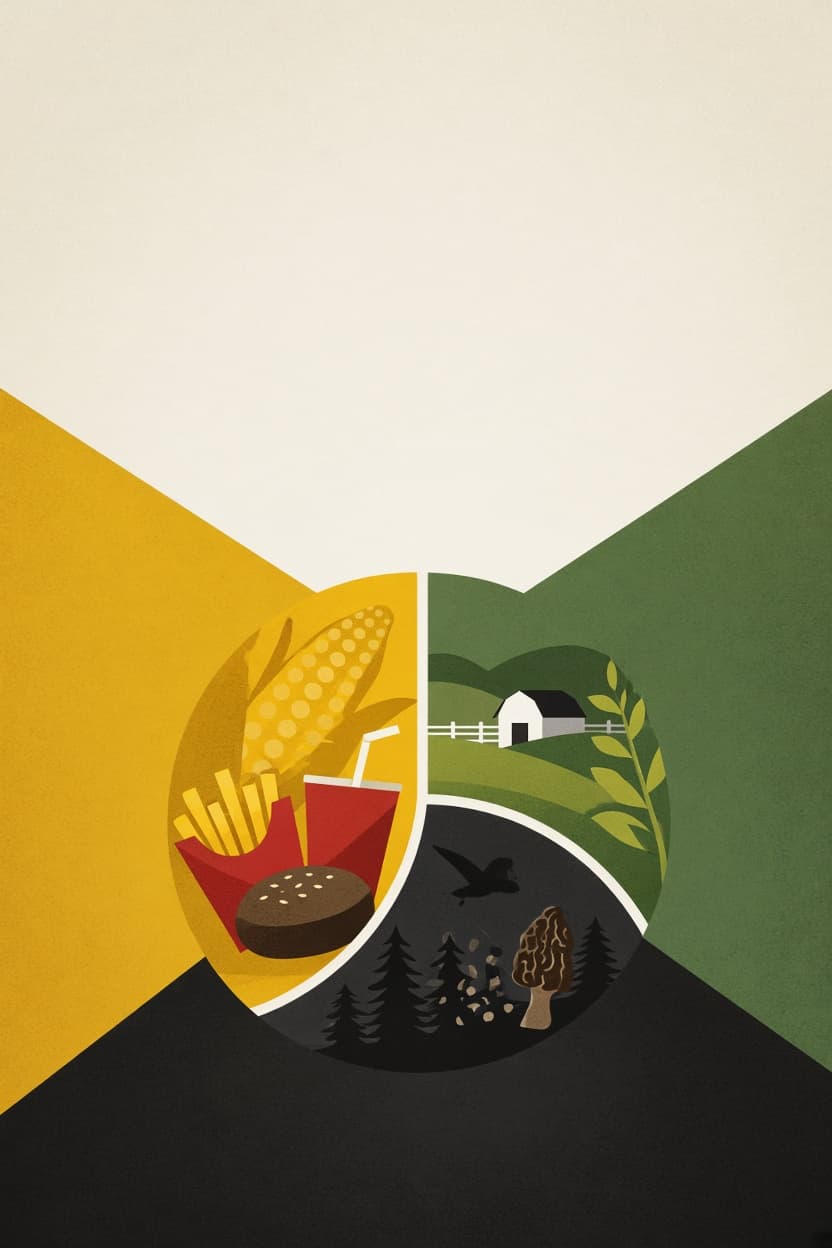
Michael Pollan traces four meals back to their origins to answer a simple question: what should we eat? He follows an industrial fast-food meal built on corn, an industrial-organic meal from Whole Foods, a meal raised on a small Virginia farm, and a meal he hunts and forages himself. The book argues that the American food system has become so distorted by cheap corn and industrial logic that eaters have lost track of where food comes from, and that regaining that knowledge is both a practical and moral project.
Reading plan
Pick a finish date and Genius lays out the days — the plan shows today's target and keeps you honest.
Read together
Start a circle and share the code — everyone sees everyone's honest place in the book. Accountability, not leaderboards.
Who it's for
- Readers who want to understand why a bag of chips and a soda are both, chemically, mostly corn - People curious whether "organic" and "local" labels actually mean what they imply - Anyone weighing the ethics of eating meat who wants a concrete, non-abstract argument to test
What’s inside
- 1The Empire of Corn1 min
American agriculture and diet have been reshaped, largely by accident, to serve one plant, and corn now runs through nearly everything Americans eat.
- 2The Feedlot and the Broken Biology of Meat1 min
Feeding corn to cattle is efficient for industry but forces animals into a diet their bodies were not built for, creating health and environmental costs that shoppers never see on the price tag.
- 3From Commodity to Product: The Food Science Machine1 min
Processing corn into thousands of branded food items creates an illusion of abundant choice while actually narrowing what people eat down to variations on the same few ingredients.
- 4Big Organic and the Limits of a Label1 min
Industrial-scale organic farming satisfies the legal definition of organic while often reproducing the same monocultures and long supply chains as conventional agriculture.
- 5Grass, Not Grain: Polyface Farm's Alternative1 min
Joel Salatin's rotational grazing system shows that treating a farm as a set of relationships between species and grass can produce food more sustainably than either the industrial or industrial-organic model.
- 6The Price of the Local Meal1 min
Eating a meal sourced entirely from a farm like Polyface exposes both the value of transparency in food and how narrow the audience is that can currently afford it.
About Michael Pollan
Michael Pollan is an American journalist and the Knight Professor of Science and Environmental Journalism at UC Berkeley. Before writing The Omnivore's Dilemma he spent two decades reporting on agriculture, gardening, and architecture for magazines including Harper's and The New York Times Magazine, work that gave him the sourcing and access behind this book's four food chains.