17 min · 14 chaptersNarrated in your voice
Original summary · AI-drafted, human-published · added by Library
What it's about
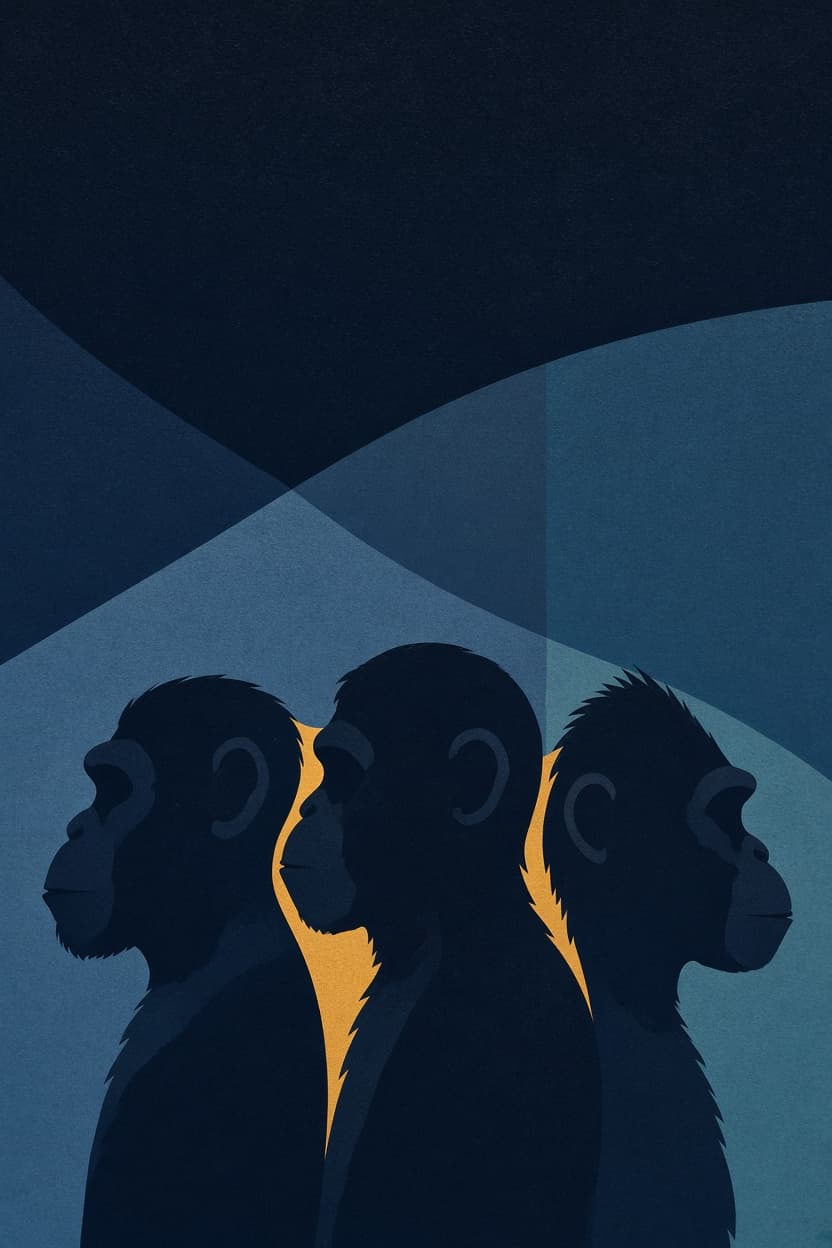
Diamond argues that humans are best understood as a third species of chimpanzee, separated from the common chimpanzee and the bonobo by a strikingly small fraction of DNA. He traces how a handful of evolved traits—language, art, agriculture, tribal loyalty—turned an unremarkable primate into a species capable of both civilization and self-destruction. The book mattered because it grounded human uniqueness in biology rather than myth, and warned, years before climate change entered mainstream debate, that our own history of ecocide could be a preview of our future.
Reading plan
Pick a finish date and Genius lays out the days — the plan shows today's target and keeps you honest.
Read together
Start a circle and share the code — everyone sees everyone's honest place in the book. Accountability, not leaderboards.
Who it's for
- Readers curious about human origins who want evolutionary biology explained without jargon - General science readers interested in why humans behave both creatively and destructively - Students of anthropology or history looking for a biological lens on cultural and political events
What’s inside
- 1A Chimpanzee With Delusions of Grandeur1 min
Human beings differ from common chimpanzees and bonobos by such a small fraction of their DNA that biologically we qualify as a third chimpanzee species, not a separate kingdom of life.
- 2The Great Leap Forward1 min
A single biological change—the emergence of fully articulate spoken language somewhere between 40,000 and 50,000 years ago—triggered an abrupt cultural explosion that gradual anatomical evolution alone cannot explain.
- 3Anatomy of a Mating System1 min
Human sexual traits, such as continuous female sexual receptivity and concealed ovulation, are evolved solutions to problems of paternity and provisioning rather than romantic accidents.
- 4Adultery and the Business of Marriage1 min
Marriage and adultery are old evolutionary strategies wearing cultural clothing, arising from the same conflicting reproductive interests that produce infidelity across the animal kingdom.
- 5Race Without Biology1 min
The concept of discrete human races is a social classification laid over continuous, overlapping human variation, not a set of natural divisions written into our genes.
- 6Why We Make Art1 min
Human art likely began as an evolved signaling behavior similar to a bowerbird's decorated nest, a costly display of skill and surplus resources, rather than a purely spiritual impulse.
- 7Agriculture's Mixed Blessing1 min
The shift from foraging to farming, usually celebrated as progress, made most individual lives worse for thousands of years by the measures that matter most: health, height, and available leisure.
- 8Our Talent for Genocide1 min
Human xenophobia and mass killing of outsiders is not a modern aberration confined to specific ideologies but a deep, recurring pattern with roots in small-scale tribal competition.
- 9The Self-Destructive Animal1 min
Human vulnerability to addictive substances is a byproduct of neural reward systems that evolved for other purposes, now exploited by concentrated chemicals nature never designed us to encounter.
- 10Ecocide: Lessons from Easter Island1 min
Environmental self-destruction, exemplified by the deforestation and societal collapse on Easter Island, shows that technologically capable societies can destroy the resources they depend on, and nothing protects modern civilization from the same fate.
- 11Are We Doomed to Repeat Ourselves?1 min
Avoiding self-destruction depends less on some special moral capacity separating humans from other animals and more on whether we consciously override the tendencies that produced our history's worst chapters.
About Jared Diamond
Jared Diamond is a physiologist, ornithologist, and geographer at UCLA. He spent decades doing fieldwork on bird evolution in New Guinea before turning to popular science writing. He later won the Pulitzer Prize for Guns, Germs, and Steel and wrote Collapse, both of which extend arguments he first raised here.
What readers say
Read next
An Immense WorldEd YongSummary17 min

IncognitoDavid EaglemanSummary10 min
MusicophiliaOliver SacksSummary12 min

The Code BreakerWalter IsaacsonSummary13 min

A Brief History of TimeStephen HawkingSummary17 min

Brief Answers to the Big QuestionsStephen HawkingSummary15 min