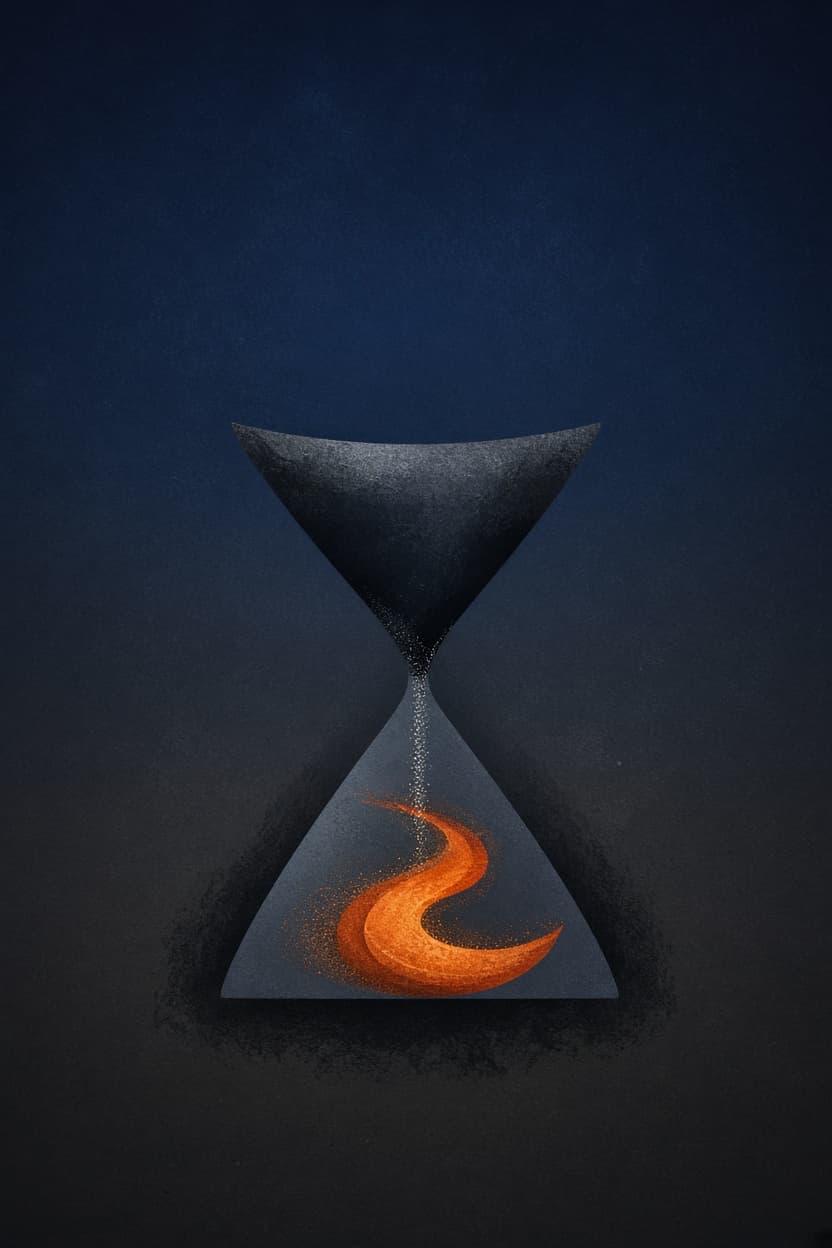
Until the End of Time
Mind, Matter, and Our Search for Meaning in an Evolving Universe
Brian Greene · 2020 · Science
13 min · 13 chaptersNarrated in your voice
Original summary · AI-drafted, human-published · added by Library
What it's about
Brian Greene argues that everything from stars to human consciousness to religion and art can be understood as temporary, local pushback against the universe's relentless drive toward disorder. Weaving physics, biology, and anthropology, he traces a single thread — entropy — from the Big Bang to the eventual heat death of the cosmos, and asks what meaning can survive the knowledge that nothing, including meaning-making itself, is permanent.
Reading plan
Pick a finish date and Genius lays out the days — the plan shows today's target and keeps you honest.
Read together
Start a circle and share the code — everyone sees everyone's honest place in the book. Accountability, not leaderboards.
Who it's for
- Readers who loved a physics book but want it connected to why they get out of bed in the morning - People wrestling with mortality or meaninglessness who want a scientific, not religious, framework for thinking about it - Science-curious readers willing to sit through dense entropy and thermodynamics chapters to reach the payoff about human culture
What’s inside
- 1Entropy Writes the Story of Time1 min
The reason time seems to flow in one direction is not a fundamental law of physics but a statistical bias toward disorder, and without that bias past and future would be indistinguishable.
- 2The Universe's Improbable Beginning1 min
Complexity — stars, planets, life — exists only because the universe began in an extraordinarily low-entropy state, and that beginning was so statistically improbable that its explanation remains open.
- 3Life as an Entropy Bargain1 min
Living things persist not by resisting the drive toward disorder but by being unusually efficient at increasing entropy in their surroundings while temporarily lowering it inside themselves.
- 4Minds Built From Matter1 min
Consciousness is most plausibly a product of ordinary physical processes in the brain, even though no current theory explains why those processes should be accompanied by subjective experience at all.
- 5Storytelling as Survival Strategy1 min
Language and narrative evolved largely as tools for coping with the unique human awareness of inevitable death, not merely as tools for communicating facts.
- 6Religion as a Response to Impermanence1 min
Religious systems function primarily as evolved and culturally reinforced tools for managing the fear of death and providing cosmic significance, rather than as accurate descriptions of an afterlife or supernatural order.
- 7Art and the Impulse to Leave a Mark1 min
Creative expression persists across every human culture because it offers a substitute form of permanence in a universe that guarantees nothing about any individual will last.
- 8Science as Meaning-Making, Not Just Discovery1 min
Science itself should be understood not as a neutral discovery of pre-existing truths but as another human strategy for imposing order and narrative on a universe that offers neither for free.
- 9The Far Future: Stars, Black Holes, and the End1 min
Every structure in the universe, including matter itself, is on a fixed and calculable trajectory toward dissolution, and the numbers involved make human history look instantaneous by comparison.
- 10Meaning Without Permanence1 min
Meaning does not require the universe's endorsement or any form of permanence to be genuine; it is fully real the moment conscious beings generate it, even knowing it will not last.
About Brian Greene
Brian Greene is a theoretical physicist and professor at Columbia University, known for his work on string theory and for popularizing physics through books including The Elegant Universe and The Fabric of the Cosmos. He co-founded the World Science Festival and has spent decades translating advanced cosmology and quantum theory for general readers.
What readers say
Read next
An Immense WorldEd YongSummary17 min

IncognitoDavid EaglemanSummary10 min
MusicophiliaOliver SacksSummary12 min

The Code BreakerWalter IsaacsonSummary13 min

A Brief History of TimeStephen HawkingSummary17 min

Brief Answers to the Big QuestionsStephen HawkingSummary15 min