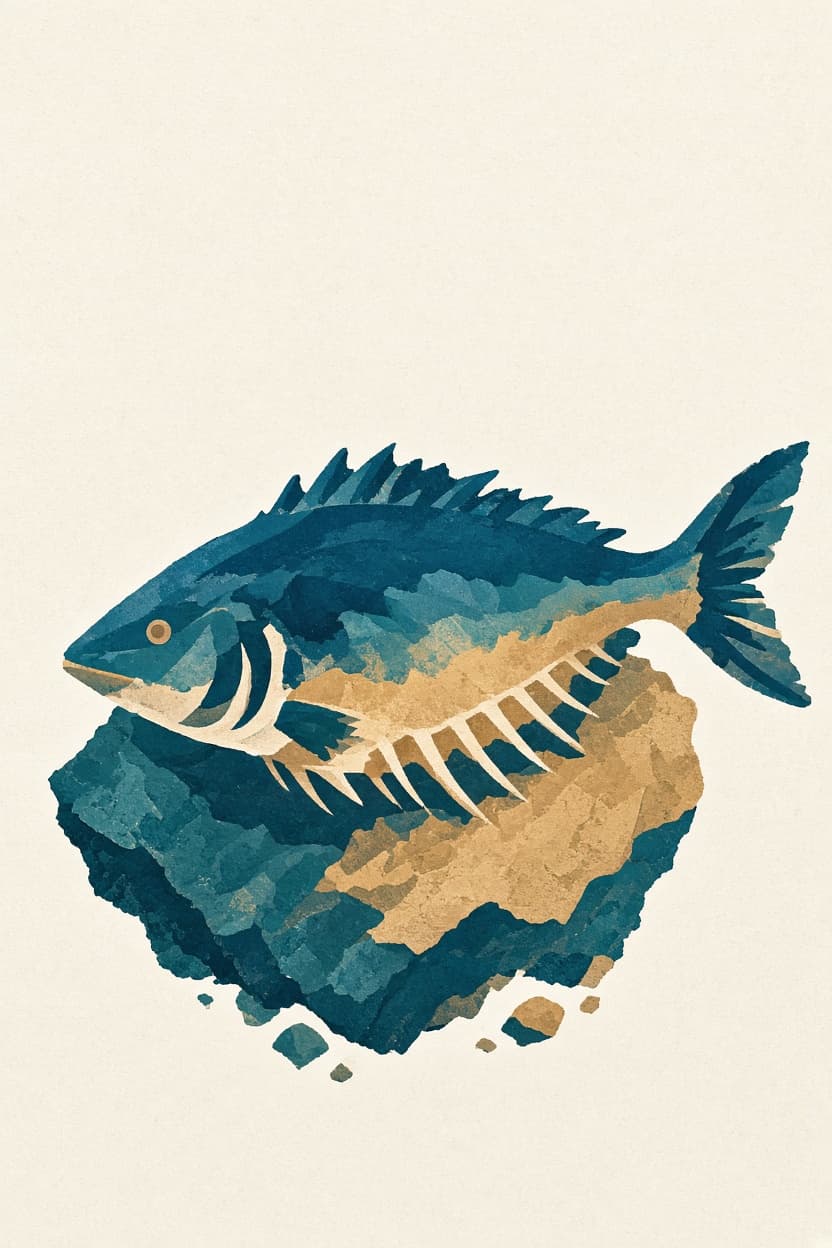
Your Inner Fish
A Journey into the 3.5-Billion-Year History of the Human Body
Neil Shubin · 2008 · Science
9 min · 10 chaptersNarrated in your voice
Original summary · AI-drafted, human-published · added by Library
What it's about
Neil Shubin, a paleontologist and anatomist, argues that the human body is a patchwork of ancient solutions repurposed across hundreds of millions of years. Using his own fossil discovery, Tiktaalik, alongside embryology and genetics, he shows that structures as varied as our hands, teeth, and hiccups trace back to fish, worms, and even single-celled ancestors. The book mattered because it made deep-time evolution tangible by locating it inside the reader's own body.
Reading plan
Pick a finish date and Genius lays out the days — the plan shows today's target and keeps you honest.
Read together
Start a circle and share the code — everyone sees everyone's honest place in the book. Accountability, not leaderboards.
Who it's for
- Curious readers who want evolution explained through their own anatomy rather than abstract theory - Students of biology looking for a bridge between paleontology, embryology, and genetics - Science-interested general readers who enjoy a working scientist narrating fieldwork and discovery
What’s inside
- 1Finding a Fish with Wrists1 min
A single fossil, deliberately hunted for in 375-million-year-old Arctic rock, can settle a transition that armchair argument cannot.
- 2Building a Body from Old Parts1 min
Limbs did not evolve as new inventions but as modifications of genetic instructions already used for fins.
- 3Heads and the Ghost of Ancient Gill Arches1 min
The vertebrate head, including human jaw and ear bones, was assembled by repurposing structures that once supported fish gills.
- 4Teeth as a Record of Deep Time1 min
The variety and layered structure of teeth reveal a long lineage of modification rather than a single perfected design.
- 5The Body Plan Written in Embryos1 min
Human embryonic development briefly recapitulates structures whose only explanation is inheritance from distant, dissimilar ancestors.
- 6Vision, Smell, and Ancient Sensory Machinery1 min
Human sensory organs, including the eye and nose, are modified versions of sensing systems that predate vertebrates entirely.
- 7Leftover Wiring and the Logic of Imperfection1 min
Bodily malfunctions such as hiccups, hernias, and hemorrhoids are direct byproducts of evolutionary history rather than design flaws to be explained away.
About Neil Shubin
Neil Shubin is a paleontologist and professor of anatomy at the University of Chicago. He co-led the Arctic expedition that discovered Tiktaalik roseae in 2004, a fossil fish with limb-like features that clarified the water-to-land transition. He has spent his career combining fossil hunting with developmental biology to explain body structure through evolutionary history.
What readers say
Read next
An Immense WorldEd YongSummary17 min

IncognitoDavid EaglemanSummary10 min
MusicophiliaOliver SacksSummary12 min
The Code BreakerWalter IsaacsonSummary13 min

A Brief History of TimeStephen HawkingSummary17 min

Brief Answers to the Big QuestionsStephen HawkingSummary15 min